Soorty, Redefining Sustainable Denim Through Innovation & Impact
This week, Pakistan Textile Council highlights Soorty, a global leader in sustainable denim, setting new benchmarks in climate action, circularity, and social inclusion.
1. Environmental
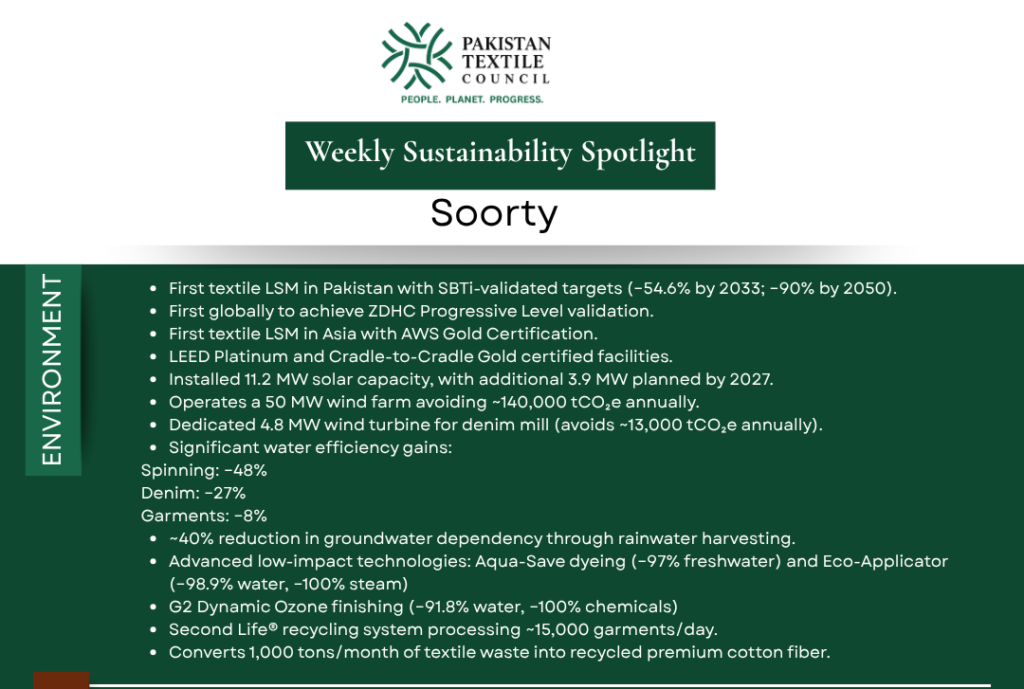
a. First textile LSM in Pakistan with SBTi-validated targets (−54.6% by 2033; −90% by 2050)
b. 50 MW wind farm + on-site renewables significantly reducing carbon footprint
c. 11.2 MW solar installed with expansion underway
d. Major water savings across operations (Spinning −48%, Denim −27%)
e. ~40% reduction in groundwater use through rainwater harvesting
f. Breakthrough technologies:

Pakistan Textile Council (PTC) is a not-for-profit public entity dedicated to advancing research and advocacy within Pakistan's textile and apparel sector. Our mission is to promote sustainable growth, economic development, and societal impact, with a commitment to prioritizing the interests of Pakistan.
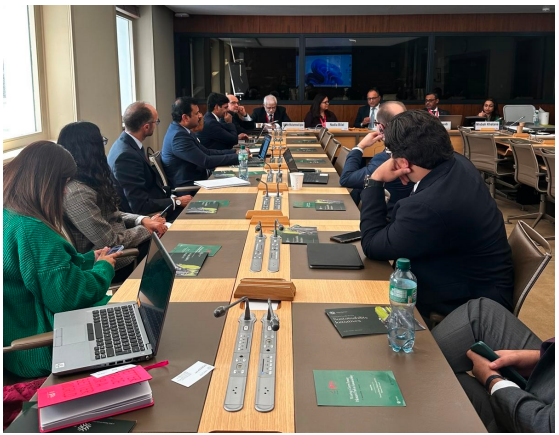
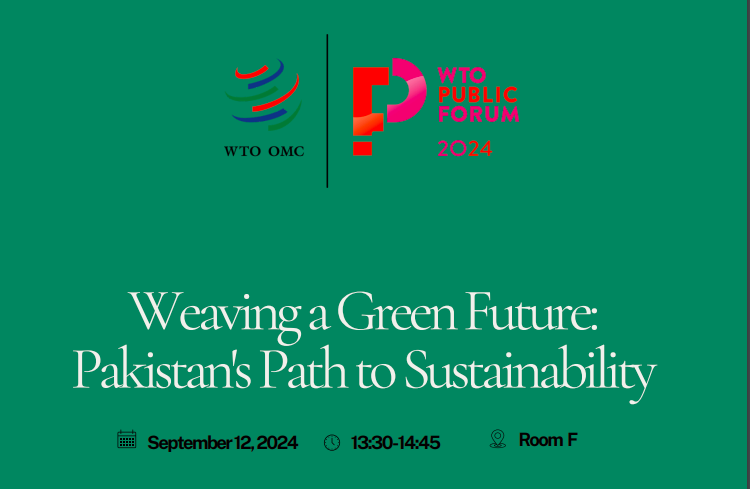
Pakistan's Path to Sustainability took place on September 12, 2024, at the WTO Public Forum in Geneva. The event, hosted by Permanent Mission of Pakistan to the WTO in collaboration with Pakistan Textile Council (PTC) was held in the Centre William Rappard.

Pakistan's textile industry, a key driver of national development ,is embracing sustainability due to domestic and global environmental concerns. While the industry empowers labor force including women and differently abled individuals and fosters social inclusion
The Pakistan Textile Council (PTC) is pleased to launch a new weekly series highlighting the ESG achievements of our member companies. This initiative reflects the sector’s collective commitment to sustainability, social responsibility, and good governance.
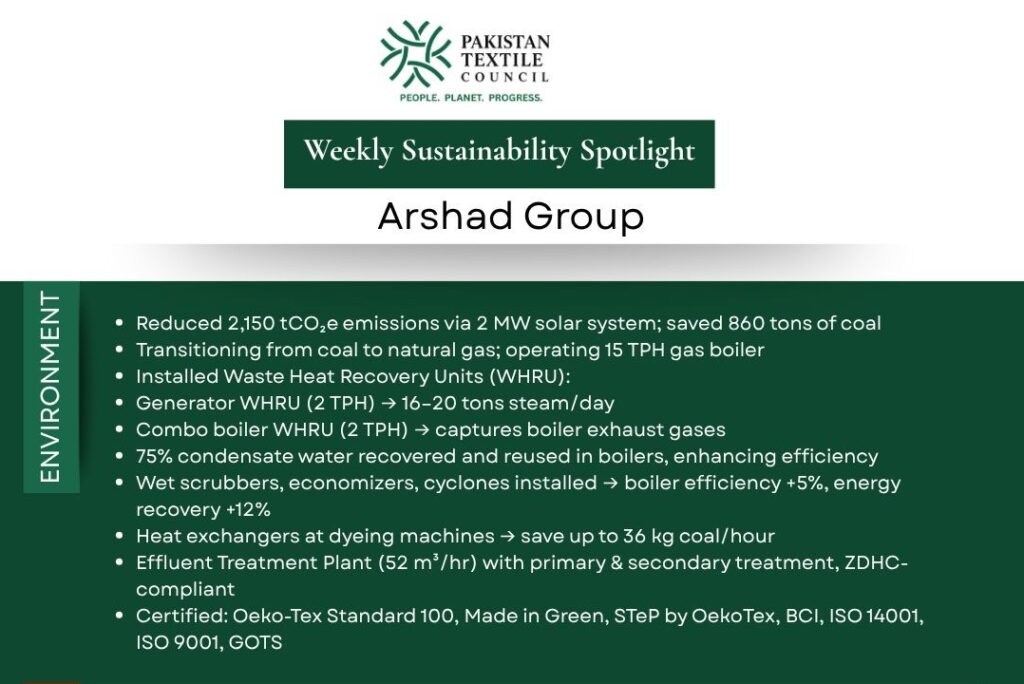
For our first feature, we are proud to showcase Arshad Group:
1. Environment
a. Reduced 2,150 tCO₂e via 2 MW solar capacity; saved 860 tons of coal
b. Transition to natural gas with a 15 TPH gas boiler
c. Waste Heat Recovery Units generating up to 20 tons steam/day
d. 75% water condensate recovery and ZDHC-compliant effluent treatment
e. Certified: Oeko-Tex Standard 100, Made in Green, STeP by OekoTex, BCI, ISO 14001, ISO 9001, GOTS
The Pakistan Textile Council (PTC) continues its Weekly Sustainability Series, spotlighting the Environmental, Social, and Governance (ESG) commitments of our member companies.
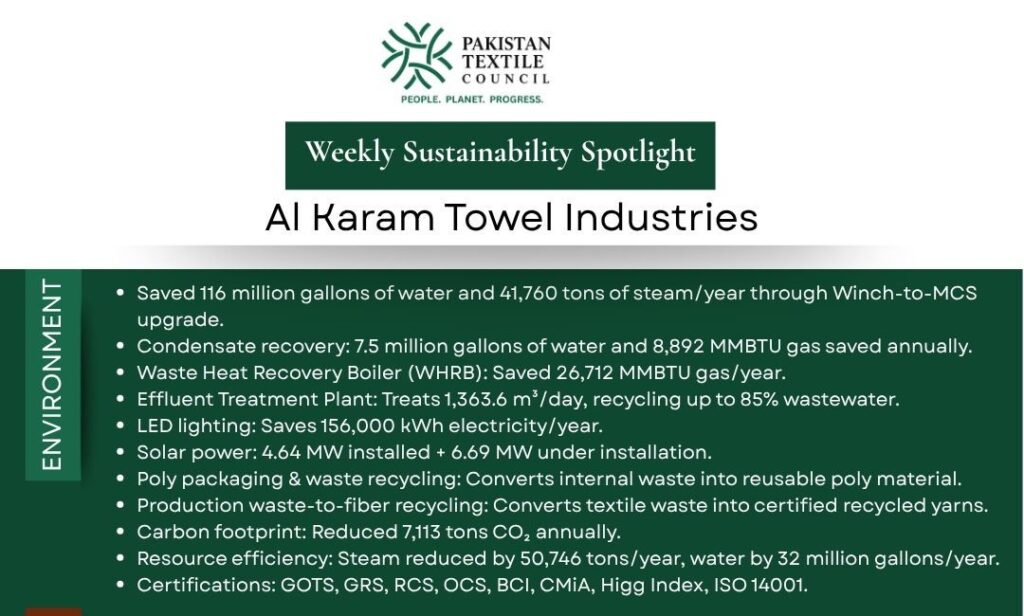
This week, we feature Al Karam Towel Industries Pvt. Ltd., a leading exporter demonstrating remarkable
progress in sustainability, social responsibility, and governance excellence.
1. Environment
a. 116 million gallons of water & 41,760 tons of steam saved annually through process
optimization
b. 4.64 MW solar capacity installed (+ 6.69 MW under installation)
The Pakistan Textile Council (PTC) continues its weekly series spotlighting the Environmental, Social, and Governance (ESG) excellence of our member companies.
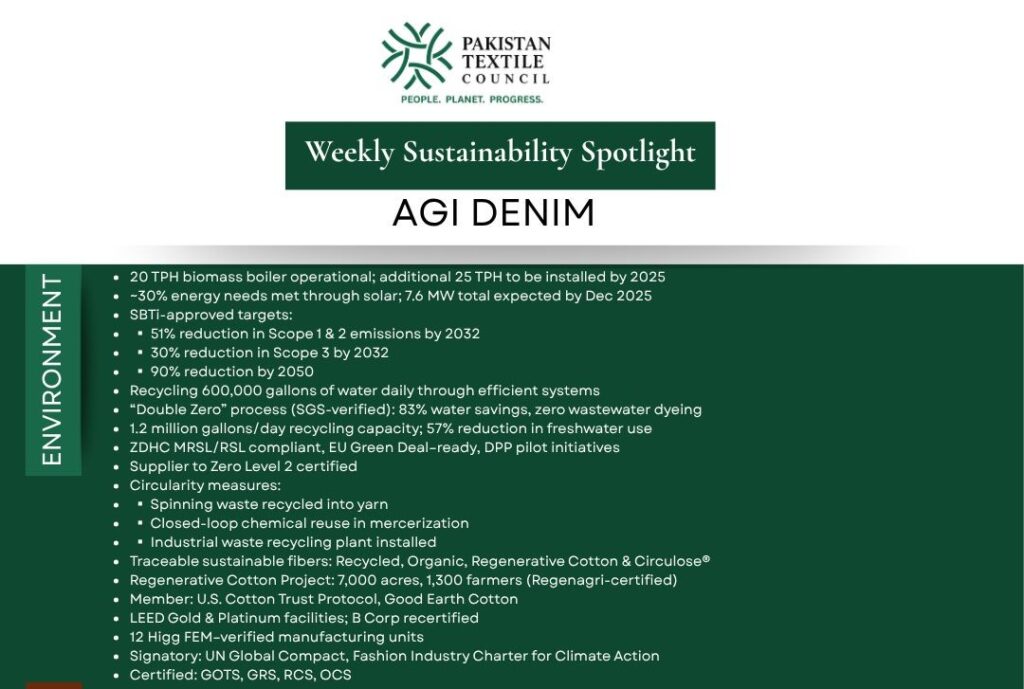
This week, we highlight Artistic Garment Industries (AGI Denim), a global leader in responsible
manufacturing, climate action, and inclusive growth, setting new benchmarks for the industry.
1. Environment
a.Renewable Energy Leadership :
30% of total energy needs met through solar (target 7.6 MW by Dec 2025)
20 TPH biomass boiler operational
b.Science-Based Targets (SBTi) :
51% reduction in Scope 1 & 2 emissions by 2032
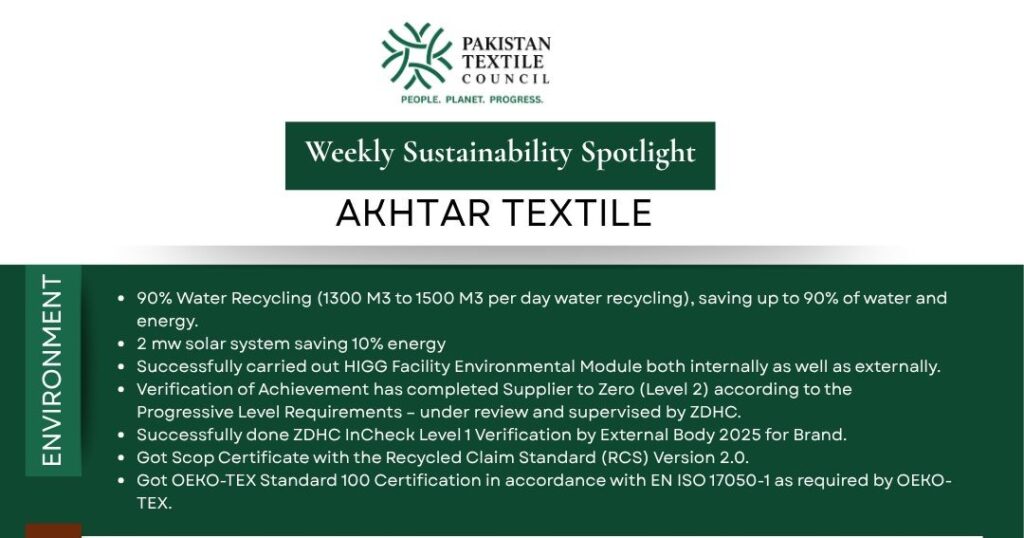
The Pakistan Textile Council (PTC) is proud to spotlight AKHTAR TEXTILE INDUSTRIES (PVT) LTD, a leading exporter championing sustainability, inclusivity, and governance excellence in Pakistan’s textile sector.
1. Environment:
a. 90% water recycling (1,300–1,500 m³/day), conserving both water & energy
b. 2 MW solar system generating 10% of total energy needs
c. Verified ZDHC Supplier to Zero (Level 2) & Higg FEM compliant
d. Certified with RCS (Recycled Claim Standard) & OEKO-TEX Standard 100
2. Social Responsibility:
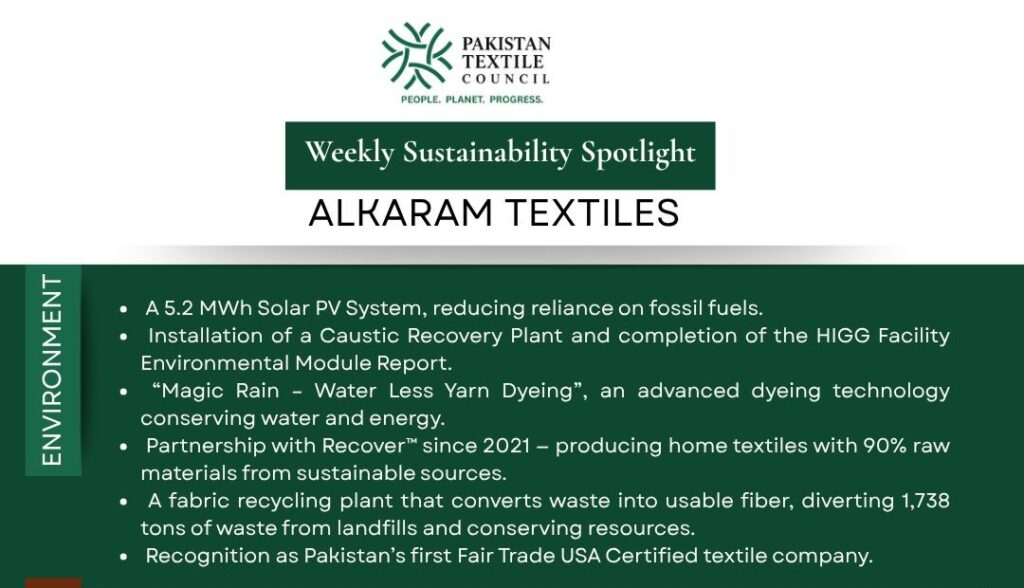
This week, we showcase Al-Karam Textile Mills Pvt. Ltd., a pioneer in sustainable innovation and community development, driving impact across environmental, social, and governance (ESG) dimensions.
1. Environment:
a. 5.2 MWh Solar PV System powering cleaner production.
b. “Magic Rain: Water Less Yarn Dyeing” technology reducing water use.
c. Collaboration with Recover™: 90% of raw materials from sustainable sources.
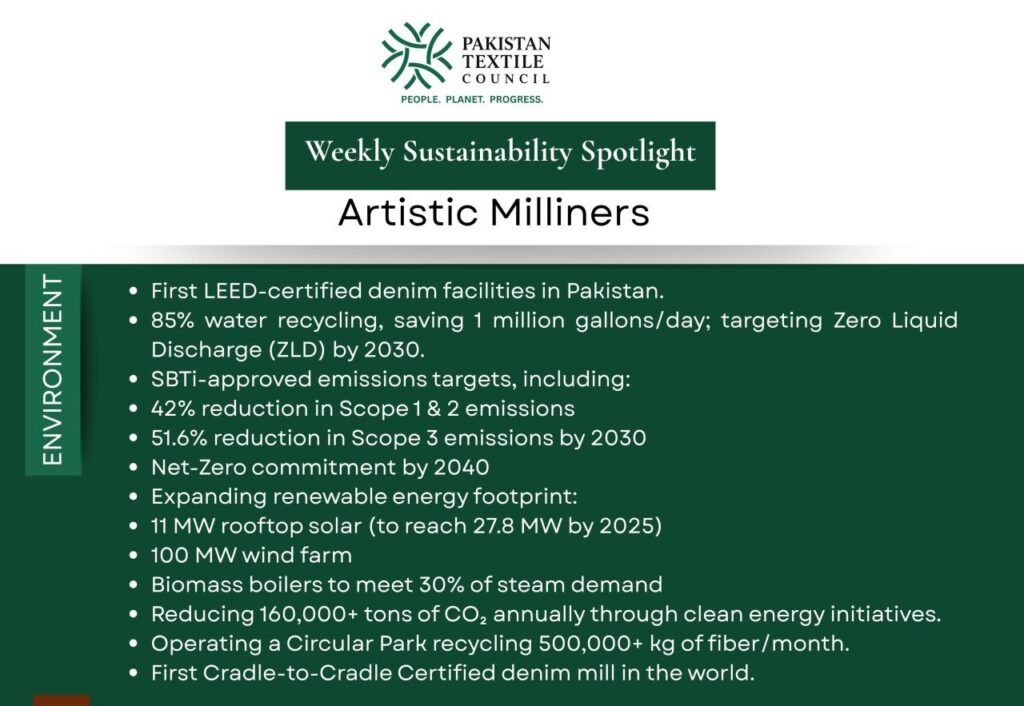
Artistic Milliners is widely recognized as one of Pakistan’s most progressive textile manufacturers, embedding sustainability into operations, culture, and supply chains.
1. Environmental Leadership
a. Pakistan’s first LEED-certified denim factories
b. 85% water recycling, saving 1 million gallons/day
c. Targeting Zero Liquid Discharge (ZLD) by 2030
d. SBTi-approved climate targets:
i. -42% Scope 1 & 2 emissions
ii. -51.6% Scope 3 emissions by 2030
iii. Net-Zero GHG emissions by 2040
e. 11 MW rooftop solar expanding to 27.8 MW by 2025
f. 100 MW wind farm + biomass boilers to supply ~30% steam needs
Featuring: Al Rahim Textile Industries Ltd, driving sustainability through innovation, safety, and responsible production.
Al Rahim Textile continues to demonstrate how sustainability and responsibility can converge to power Pakistan’s textile transformation.
1. Environment
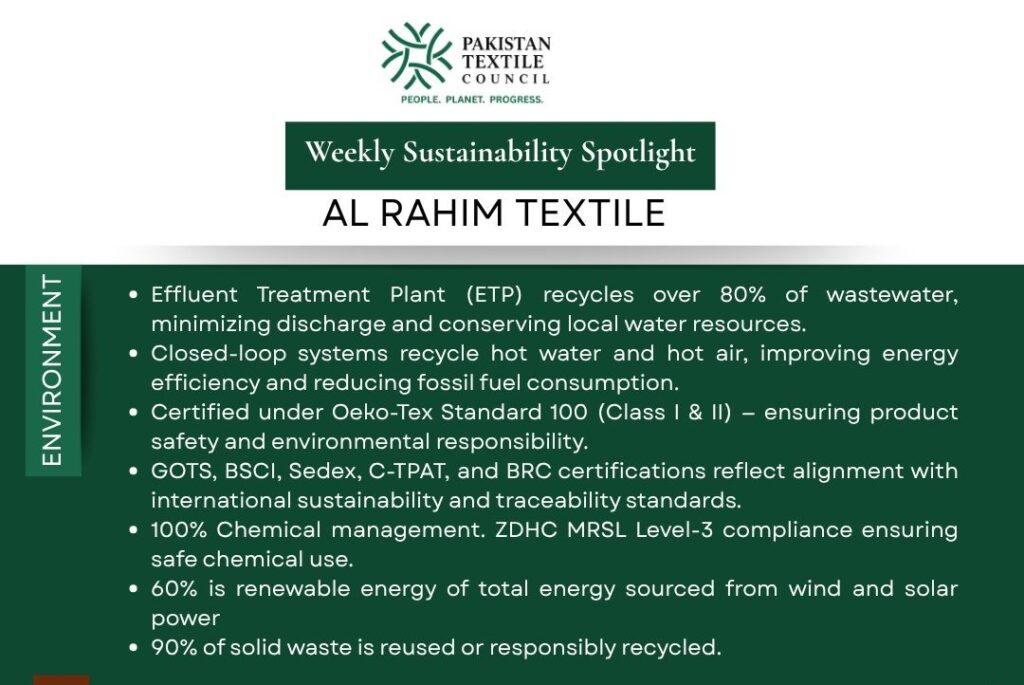
a. Effluent Treatment Plant (ETP) recycles over 80% of wastewater, minimizing discharge and
conserving community water resources.
b. Closed-loop recovery systems reuse hot water and hot air, improving energy efficiency and
lowering fossil fuel consumption.
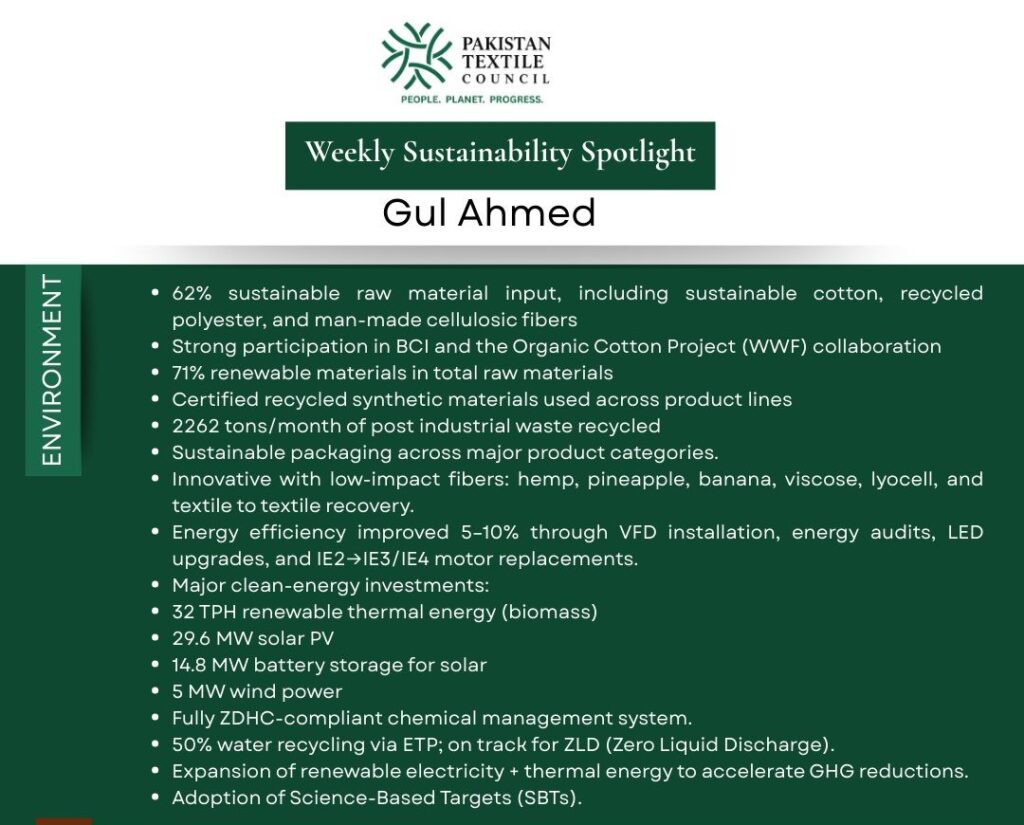
Featuring: Gul Ahmed Textile Mills Limited, advancing sustainability from fiber to factory.
Gul Ahmed continues to push the boundaries of sustainable manufacturing through circular materials, clean energy, responsible chemical use, and strong governance systems.
1. Environment
a. 62% sustainable raw materials, including BCI cotton & WWF-supported Organic Cotton Project
b. 71% renewable fibers (cotton, lyocell, viscose, hemp, banana, pineapple fibers)
c. Certified recycled synthetics + 2,262 tons/month post-industrial waste recycling
d. Energy efficiency increased 5–10% through VFDs, LED transformation & IE4 motors
e. 29.6 MW solar, 5 MW wind, 32 TPH biomass, + 14.8 MW battery storage
f. Clear GHG reduction roadmap aligned with Science-Based Targets
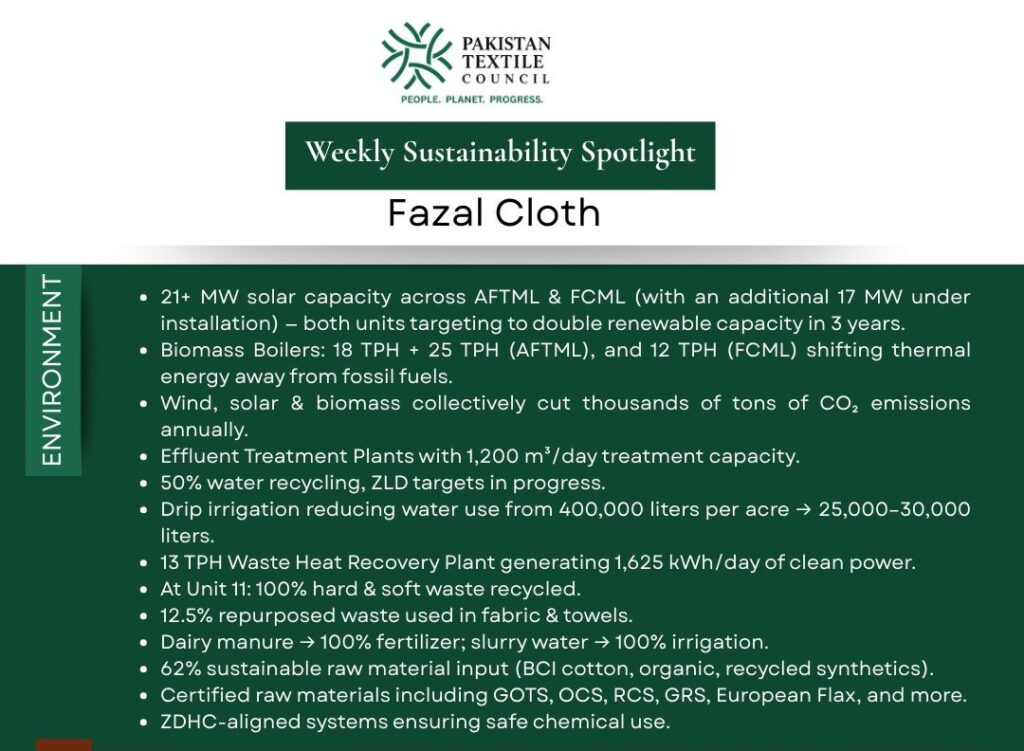
This week, we feature Fazal Cloth Mills Limited (FCML), a company raising the bar for sustainability in Pakistan’s textile industry through cleaner production, stronger communities, and transparent governance.
1. Environmental (E)
a. Large-scale solar installations across facilities + major expansions underway
b. Biomass boilers replacing fossil fuels
c. Effluent Treatment Plant treating 1,200 m³/day & 50% water recycling
d. 100% hard & soft waste recycling at Unit 11 + circular reuse in production
e. Full reuse of dairy waste as fertilizer & irrigation slurry
f. Global certifications including GOTS, OCS, RCS, GRS, Oeko-Tex, BCI, Higg FEM, SEDEX, SLCP, SA8000 and more
2. Social (S)
a. 10% women workforce in Towel Division; target: 25% by 2030
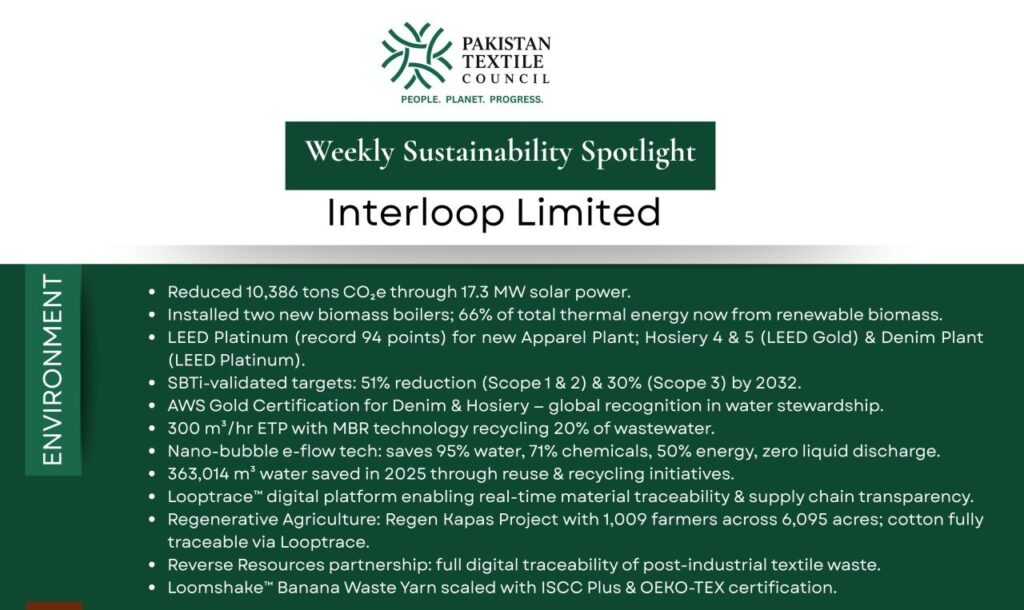
This week, we spotlight Interloop Limited, a company redefining environmental responsibility, social impact, and governance excellence across the textile value chain.
1. Environment
a. 17.3 MW solar power cutting 10,386 tons CO₂e
b. Advanced biomass boilers → 66% renewable thermal energy
c. LEED Platinum Apparel Plant (record 94 points worldwide)
d. SBTi-validated targets:
▪️ -51% Scope 1 & 2 emissions
▪️ -30% Scope 3 emissions
e. AWS Gold Certification for water stewardship
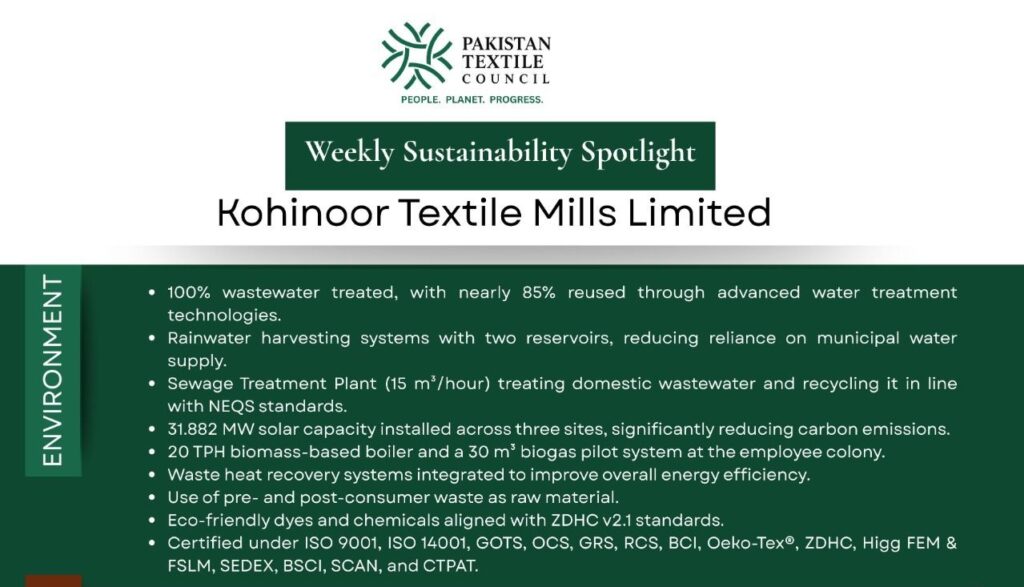
This week, we highlight how Kohinoor Textile Mills Limited, Kohinoor Maple Leaf Group is embedding sustainability across its operations from water stewardship and clean energy to inclusive workplaces and strong governance.
1. Environmental
a. 100% wastewater treated; ~85% reused through advanced water treatment
b. Rainwater harvesting reservoirs reducing dependence on municipal supply
c. 31.9 MW solar capacity across three sites
d. Biomass boiler (20 TPH) & biogas pilot system supporting renewable energy
e. Waste heat recovery systems improving energy efficiency
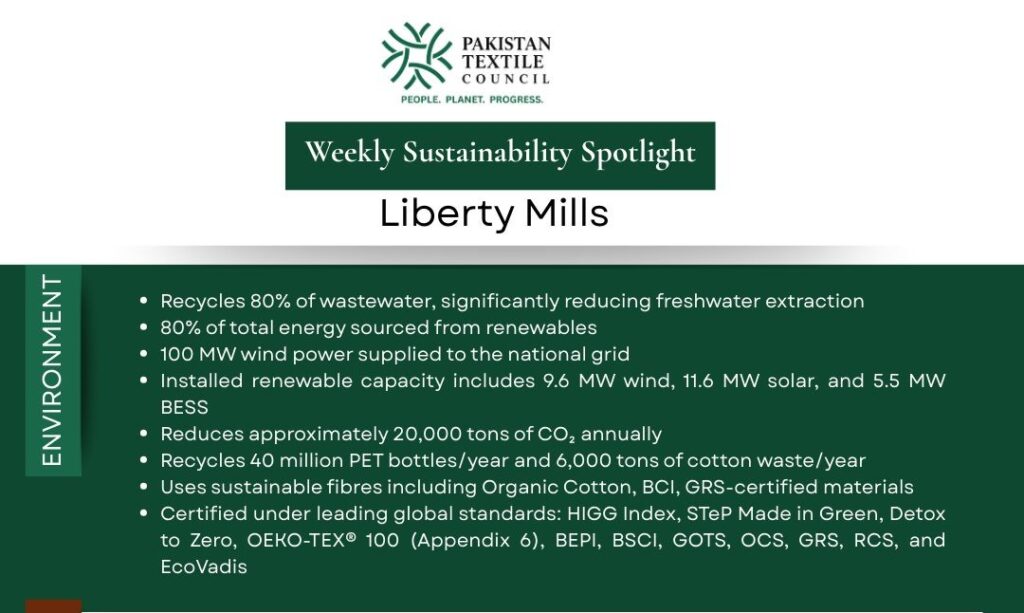
At Liberty Mills, sustainability is embedded across Environment, Social, and Governance (ESG) delivering measurable impact for people, planet, and industry.
1. Environment
a. 80% wastewater recycled
b. 80% of total energy from renewables
c. 100 MW wind power supplied to the national grid
d. 9.6 MW wind | 11.6 MW solar | 5.5 MW BESS installed
e. ~20,000 tons CO₂ reduced annually
f. 40M PET bottles & 6,000 tons cotton waste recycled each year
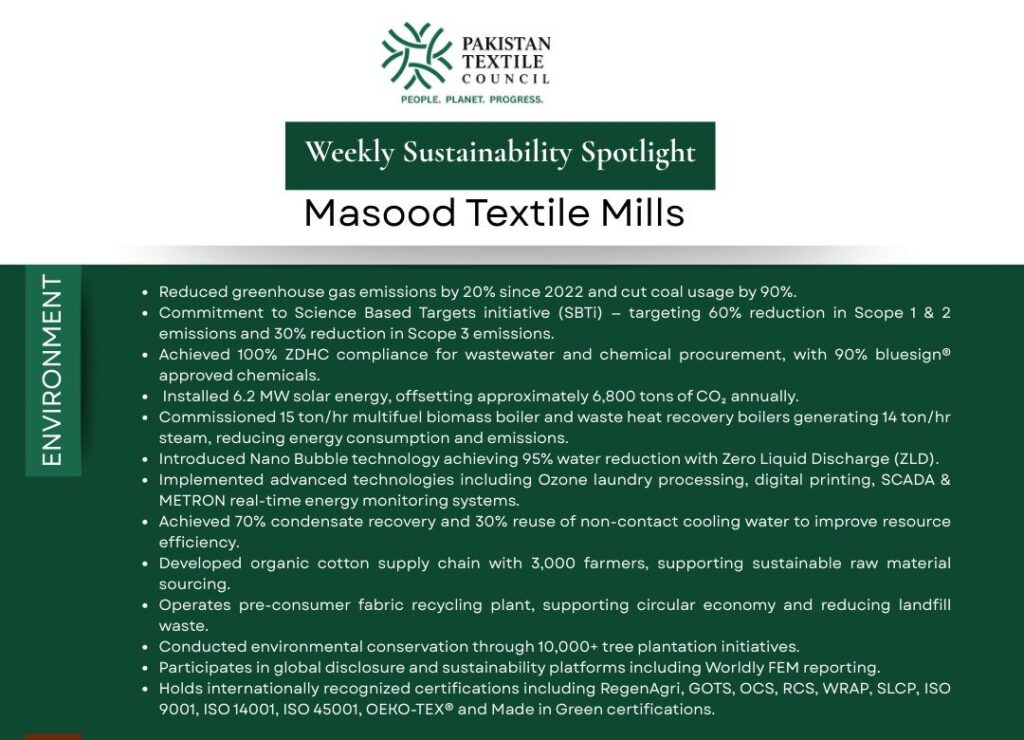
Masood Textile Mills Limited, Driving Innovation Through Sustainability
Masood Textiles Mills is actively reducing its environmental footprint through measurable climate and resource efficiency initiatives. This week, we highlight Masood Textiles Mills, a company integrating environmental stewardship, social responsibility, and strong governance into its operational strategy.
1. Environmental
a. 20% reduction in GHG emissions since 2022 & 90% reduction in coal usage
b. SBTi commitment targeting 60% reduction in Scope 1 & 2 emissions and 30% Scope 3
reduction
c. Installation of 6.2 MW solar energy, offsetting 6,800 tons of CO₂ annually
d. Nano-bubble technology achieving 95% water savings with Zero Liquid Discharge
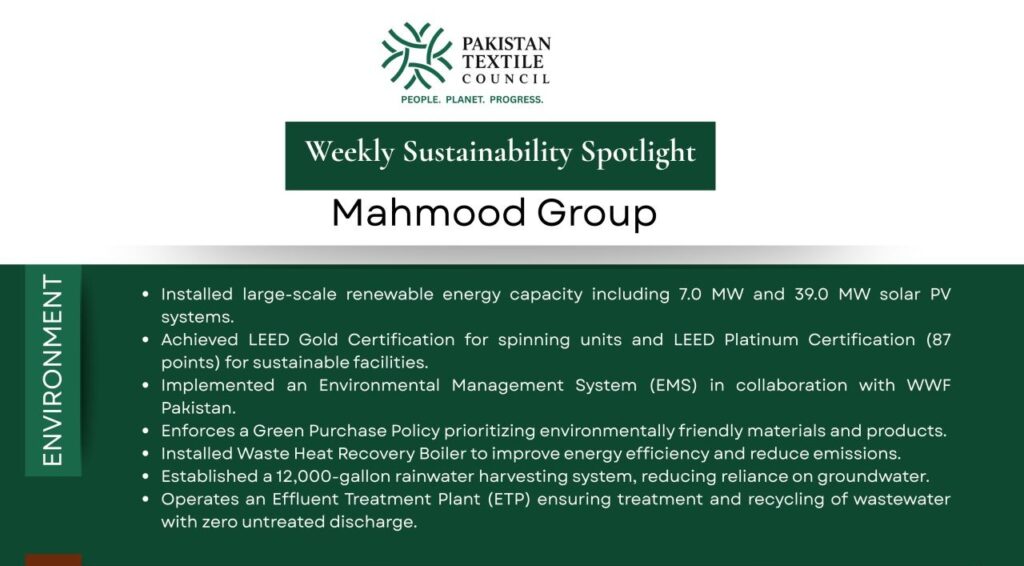
Mahmood Group of Industries: Powering Growth Through Sustainability & Community Impact
This week, Pakistan Textile Council highlights Mahmood Group, a leading example of how sustainability, social investment, and governance excellence can operate hand-in-hand.
1. Environmental
a. 46+ MW Solar PV Installed (7 MW + 39 MW)
b. LEED Gold & LEED Platinum (87 Points) Certified Facilities
c. Waste Heat Recovery Boiler for enhanced energy efficiency
d. 12,000-gallon rainwater harvesting system reducing groundwater reliance
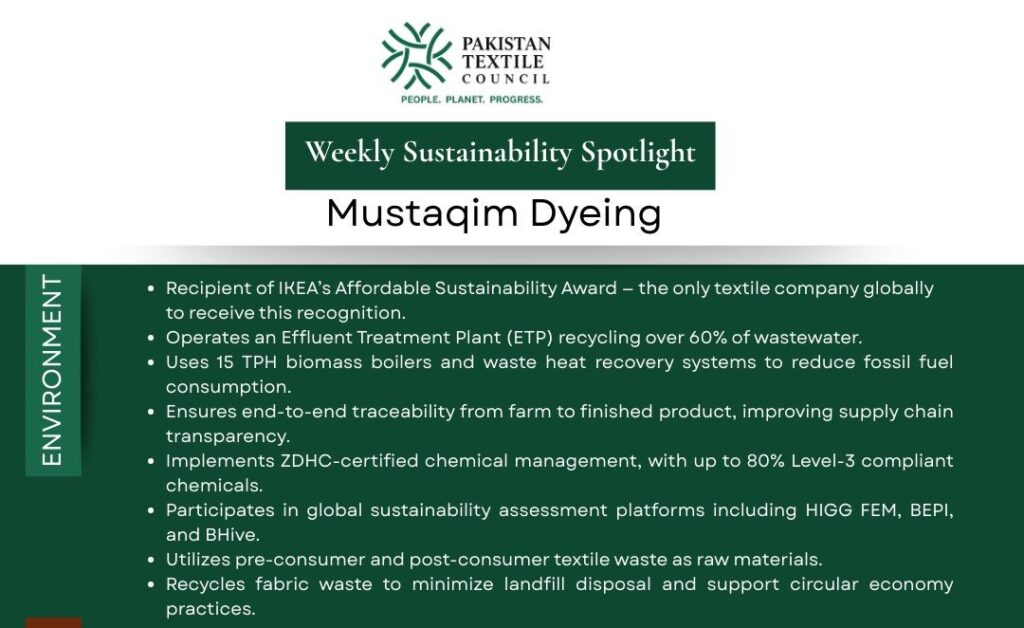
Mustaqim Dyeing & Printing Industries (Pvt.) Ltd., Advancing Circularity & Responsible Manufacturing
Pakistan’s textile sector continues to strengthen its sustainability footprint. This week, Pakistan Textile Council highlights Mustaqim Dyeing, a company integrating environmental innovation, social responsibility, and strong governance practices.
1. Environmental
a. Recipient of IKEA’s Affordable Sustainability Award the only textile company globally to receive this recognition.
b. Effluent Treatment Plant recycling 60%+ wastewater.
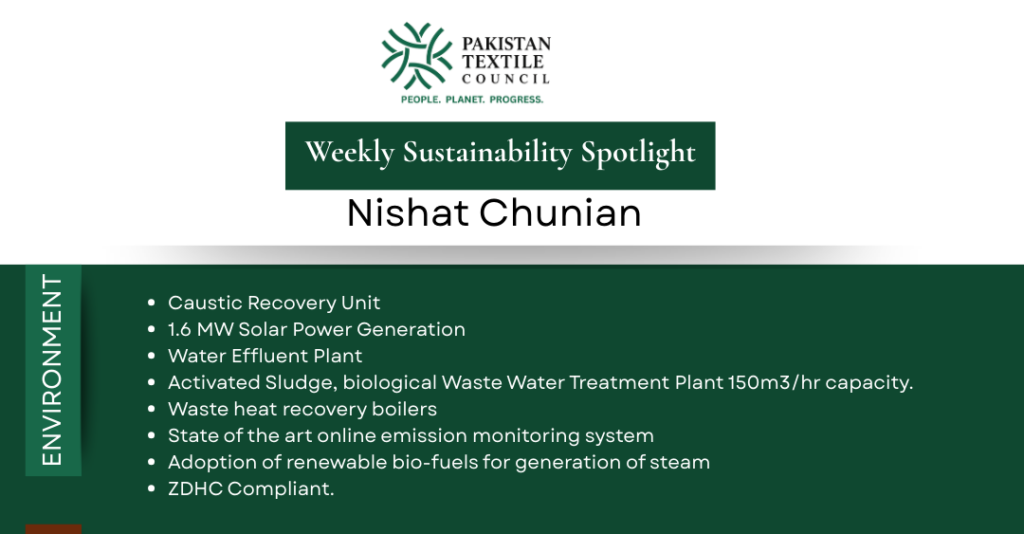
Nishat Chunian Limited, Integrating Sustainability with Scale
This week, Pakistan Textile Council highlights Nishat Chunian Limited (NCL), a company embedding sustainability across operations through resource efficiency, social investment, and strong governance frameworks.
1. Environmental
a. 1.6 MW Solar Power Generation supporting clean energy transition
b. Caustic Recovery Unit improving chemical reuse & efficiency
c. Advanced Effluent Treatment Plant (150 m³/hr) with biological treatment systems
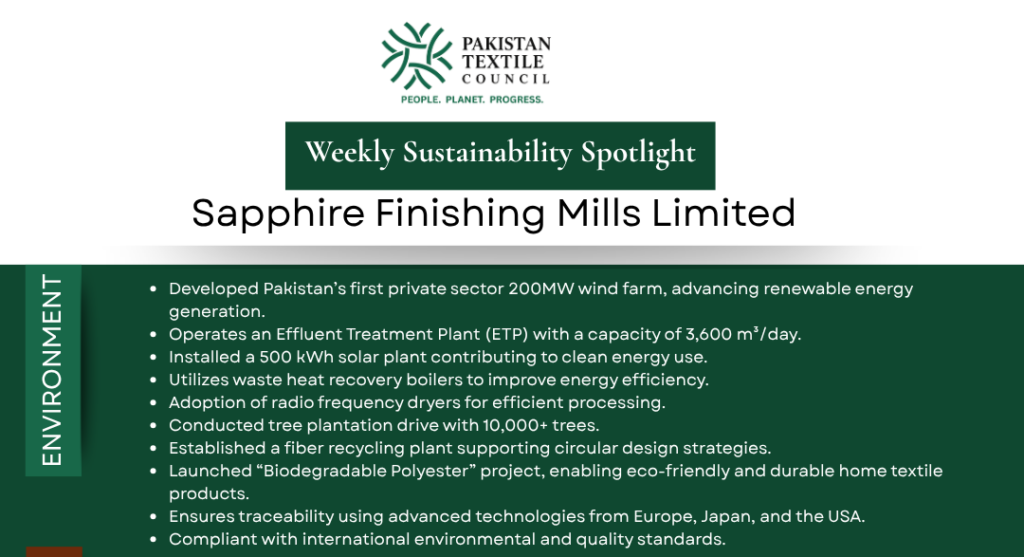
Sapphire Finishing Mills Limited (SFML), Powering Sustainability Through Innovation & Impact
Pakistan Textile Council highlights SFML, a leading player driving sustainability through renewable energy, circular innovation, and strong social impact.
1. Environmental
a. Pakistan’s first private-sector 200MW wind farm a major milestone in renewable energy
b. Effluent Treatment Plant (3,600 m³/day capacity) ensuring responsible water management